VR Controller Tracking Systems: How Motion Prediction Works
By Clara Nguyen • 31st Mar
VR controller tracking systems and motion prediction VR controllers form the backbone of responsive, immersive gameplay, but most players never see the engineering underneath. The system that maps your hand movements onto a virtual screen happens in milliseconds, involving competing technologies, predictive algorithms, and carefully measured trade-offs between precision and practicality. Understanding how these systems work reveals why some controllers feel responsive while others lag, and more importantly, where you actually need to spend your budget.
What You're Really Buying: Tracking Fundamentals
Tracking in VR is the continuous detection of the position and orientation of your controllers within physical space. This seems straightforward until you realize your headset needs to know where your hands are 90+ times per second while you're moving at variable speeds, sometimes with the controllers partially hidden. Every millisecond of delay between your movement and what the screen displays affects perceived responsiveness (a factor that matters more than raw horsepower for competitive play).
The system that maps your hand movements onto a virtual screen happens in milliseconds, involving competing technologies, predictive algorithms, and carefully measured trade-offs between precision and practicality.
Two architectural approaches dominate: inside-out tracking and outside-in tracking. Each reflects a different philosophy about where the intelligence lives, either on your headset or in your room.
Inside-Out vs. Outside-In: The Trade-Off Framework
Inside-out tracking places cameras and sensors directly on your VR headset. The system uses algorithms like SLAM (Simultaneous Localization and Mapping) to analyze visual data from the headset's cameras, tracking features in your room to estimate movement. Devices like the Meta Quest series use this approach. For platform-by-platform accuracy and comfort metrics, see our VR controller comparison 2025.
The practical advantage is obvious: portability. No base stations. No wiring. No setup. However, the cost is accuracy under difficult conditions. Inside-out systems struggle in low-light environments or featureless rooms (think a blank white wall), and controllers lose tracking when they leave the headset's camera field of view. For casual gameplay, this matters less. For precision-dependent scenarios (architectural visualization, surgical simulation, competitive rhythm games) it introduces noticeable gaps.
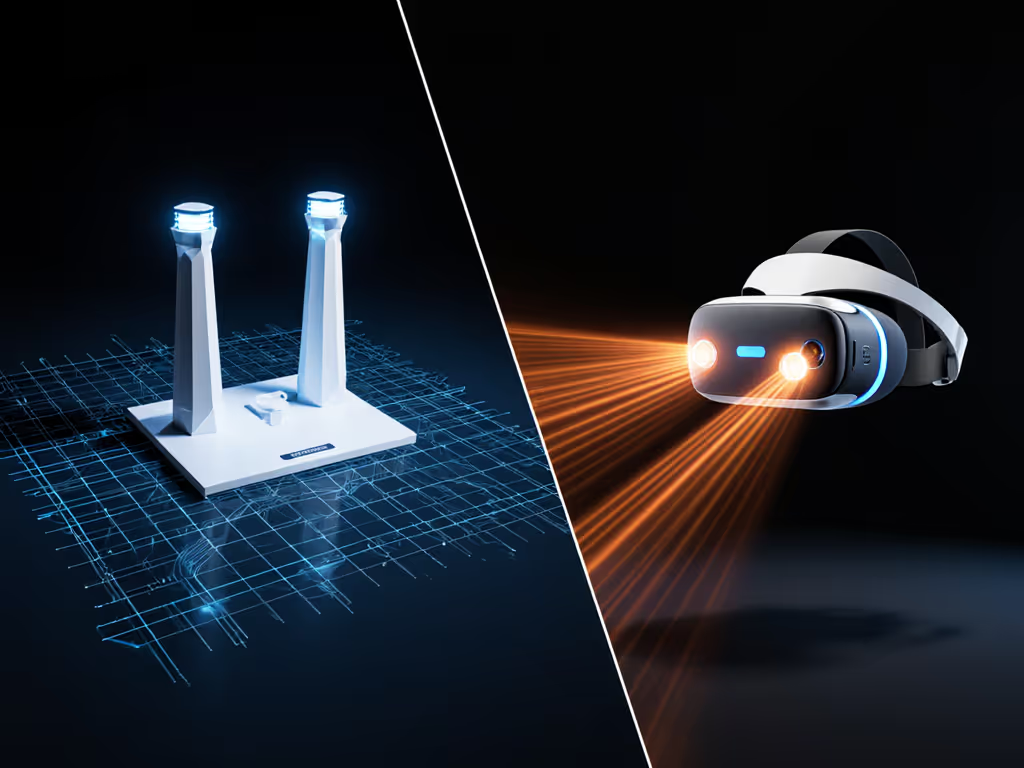
Outside-in tracking inverts the logic entirely. External sensors or base stations placed in your environment emit infrared light or lasers that your controllers detect. The HTC Vive and Valve Index use this lighthouse approach. PlayStation VR uses a single external camera.
Outside-in delivers higher precision and lower latency because the math is simpler: if the base stations know exactly where they are, and they can see exactly where your controllers are in relation to them, position calculation is direct rather than inferential. Testing shows the Vive system achieves accuracy in the lower millimeter range for position detection, though systematic deviations in the centimeter range appear with multiple base stations, and rotational accuracy sits around 0.4°.
The trade-off is setup complexity and reduced portability. You need space. You need to mount hardware. That permanent installation is friction most casual players won't tolerate, but it's a non-issue in dedicated gaming spaces.
Motion Prediction: Hiding Latency Where It Matters
Even with excellent real-time tracking, a gap always exists between your physical movement and what appears on screen. Predictive tracking attempts to close this gap by estimating where your controller will be in the immediate future rather than using only its current measured position.
This sounds like guesswork, and it is, but educated guesswork. Dive deeper into ML-based motion prediction and how controllers forecast your next move. If your hand is moving rightward at a measurable velocity, predicting it will continue rightward for the next 20 milliseconds is statistically sound for most natural movements. One common application reduces the apparent 'motion-to-photon' latency, meaning the time between movement and when that movement is reflected on the display.
The practical effect: a predicted frame feels responsive because the visual feedback anticipates your motion slightly rather than trailing behind it. For competitive gamers, especially in fast-paced titles, this perception of snappiness directly impacts performance.
Sensor Fusion: Combining Multiple Data Streams
Modern tracking systems don't rely on a single input stream. Sensor fusion combines data from cameras, infrared LED detection, inertial measurement units (IMUs), and even ultrasound sensors within a unified framework.
Microsoft's approach exemplifies this: Windows Mixed Reality controllers use vision-based LED constellation tracking for baseline position, but that system suffers in sunlight and when controllers move out of camera field of view. Their solution fuses ultrasound ranging data from both the controller and headset, then combines that output with a predictive model built on recurrent neural networks (RNNs). The final result feeds through a Kalman Filter, which mathematically blends different positional estimates to produce a single, more stable output.
What this engineering delivers in plain terms: the system gracefully degrades rather than suddenly losing tracking. Accuracy decreases in edge cases, but you don't get the jittery or lost-tracking experience of a single-method approach.
The Accuracy You Actually Get: Velocity Matters
Tracking accuracy is not absolute; it depends heavily on how fast you're moving. This detail matters because it explains why your controller feels solid during slow, deliberate aiming but potentially glitchy during rapid sweeping motions.
Test data reveals the specificity: when moving at high velocity (around 900 mm/s), one tracker showed only 45% of data with positional error under 10 mm, with tracking loss reaching 34%. Reduce movement speed below 135 mm/s, and tracking loss drops below 0.5% across all device types. The headset itself maintains the best accuracy even at higher velocities, followed by controllers, then trackers (a hierarchy that reflects the engineering priority of keeping the player's viewpoint stable above all else).
For practical gaming, this means precision-dependent interactions (drawing, aiming, precise placement) benefit from slower, deliberate movements that stay within the system's comfort zone. Rapid flailing remains possible but at the cost of some temporal precision.
What This Means for Your Setup
The choice between inside-out and outside-in isn't about which is "better"; it is about which trade-off suits your situation. Inside-out wins for flexibility and simplicity. You want to move your gaming to a friend's place, a different room, or occasionally play standing in your living room? Inside-out systems adapt instantly.
Outside-in wins when precision and latency predictability matter more than convenience. You're setting up a dedicated space where millimeter accuracy enables your best performance, or you're running a commercial installation where reliability and consistent behavior across thousands of hours of use is non-negotiable.
For most players, inside-out tracking has crossed the threshold of "good enough" for general gaming. The limitations appear in edge cases rather than moment-to-moment play. But if you're chasing competitive performance or working with content where precision directly affects quality (professional visualization, training simulation), outside-in's extra investment in hardware pays dividends.
Spend where input matters, save where branding doesn't.
The tracking system you choose shapes your daily experience far more than controller aesthetics or RGB lighting. Pay attention to the technical foundation before getting distracted by cosmetics.
Next Steps: Evaluate Your Space and Use Case
Before choosing a VR system, audit two factors: your physical environment and your performance requirements.
First, honestly assess your typical play space. Do you have a dedicated room that stays dark and feature-rich? Can you mount hardware permanently? Are you playing primarily in well-lit living rooms with minimal wall detail? Inside-out systems like the Meta Quest line tolerate varied conditions better. Dedicated spaces with mounted base stations unlock outside-in's precision advantages.
Second, define what "responsive" means for your games. Casual play and social VR tolerate latency well. If you're sensitive to nausea, see controllers that reduce VR motion sickness. Competitive shooters, rhythm games, and precision-dependent work benefit measurably from lower latency and tighter tracking. If you're in that performance-sensitive category, outside-in's added complexity becomes worthwhile rather than frustrating.
Finally, test before committing. Most VR arcades and retail locations have systems you can try. Spend 10 minutes with inside-out and outside-in tracking back to back, preferably with the same game. You'll feel the difference in responsiveness immediately, not as a number, but as confidence in your hand-to-screen connection. To understand why that 'in-the-body' feeling matters, read our proprioception in controllers. That felt difference is real, measurable in milliseconds, and the only metric that ultimately matters.
Related Articles