Ultrasonic Haptics Explained: Physics Behind Precision Feedback
By Aisha El-Sayed • 10th May
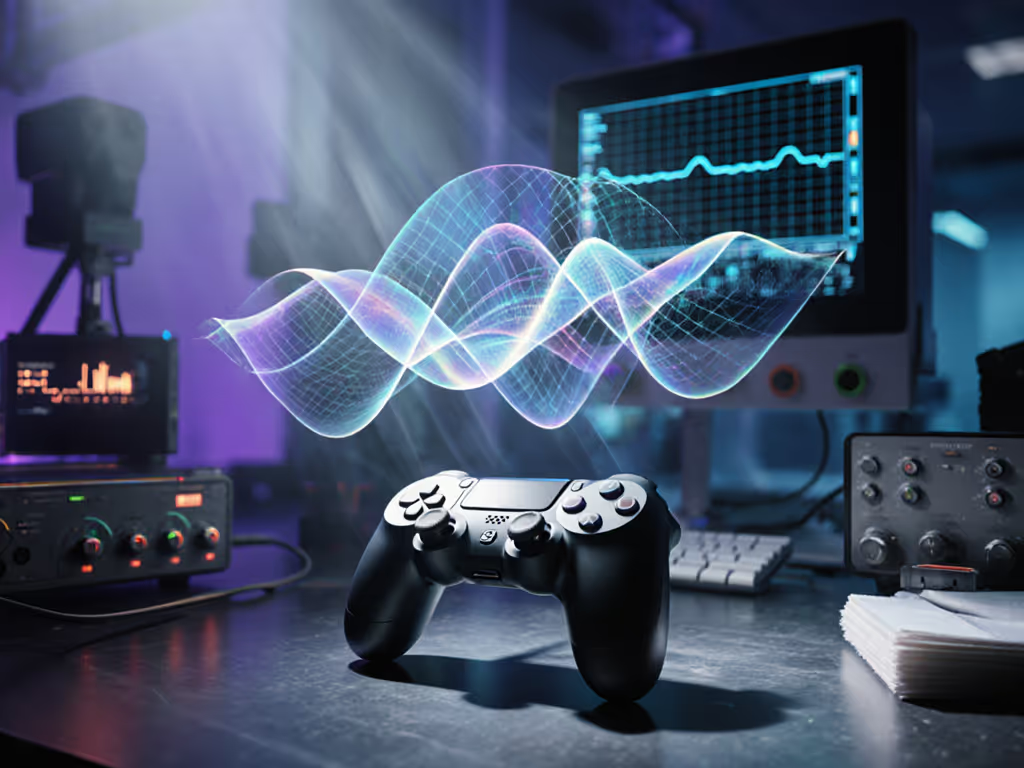
Ultrasonic haptics explained starts with one core idea: you can feel focused sound on your skin without anything physically touching you, and ultrasonic haptics technology uses that to deliver extremely precise, low-latency tactile cues. This FAQ deep dive unpacks the physics behind that precision haptic feedback and what it can mean for more comfortable, high-performance controllers.
Check fit before specs.
What are ultrasonic haptics, in simple terms?
Ultrasonic haptic feedback is a type of tactile response technology that uses high-frequency sound waves (ultrasound) to create tiny forces on your skin, so you feel taps, textures, or motion in mid-air.[6][8]
- Ultrasound here means sound above 20 kHz - well beyond what human hearing can detect.[6][8]
- Typical systems use arrays of transducers operating around 40 kHz, similar to common ultrasonic distance sensors.[1][6]
Unlike a traditional rumble motor that shakes the whole controller, ultrasonic haptics can concentrate force into very small regions, even a few millimeters across, by focusing the sound field.[1][5][7] For a side-by-side engineering comparison, see our ultrasonic vs rumble latency tests.
That focusing is why this approach is so interesting for players chasing both immersion and clarity: instead of "the whole pad is buzzing," you can in principle feel very specific, localized cues.
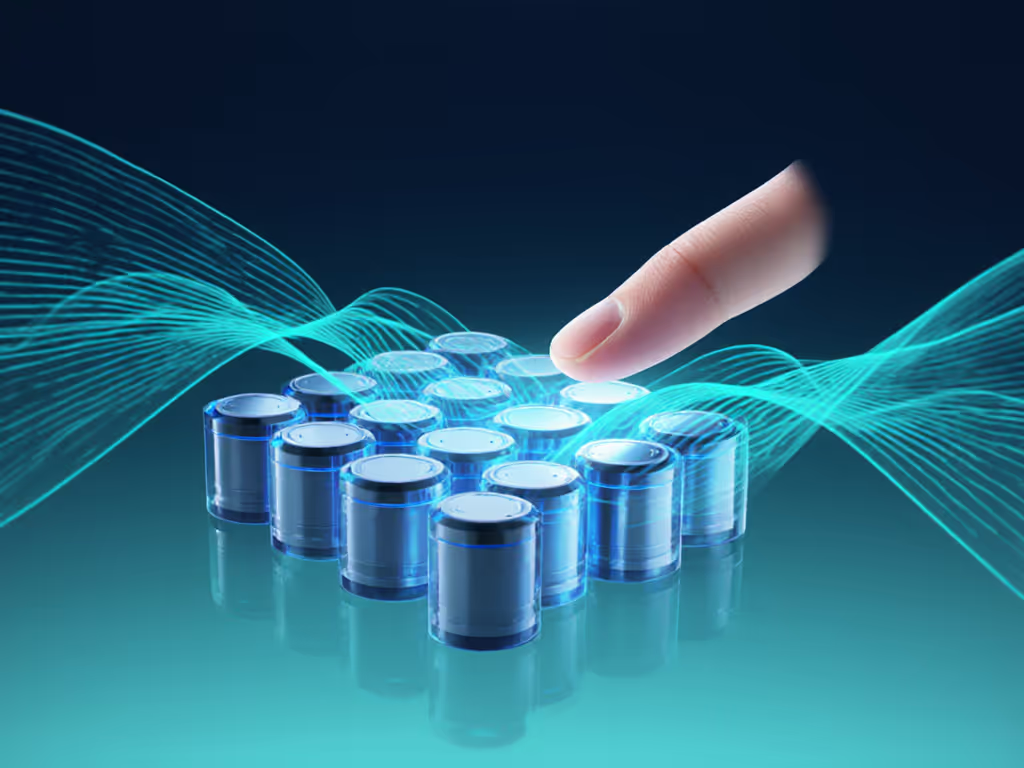
How does ultrasound create a feeling of touch?
The key physical mechanism is acoustic radiation pressure - a steady force exerted by intense sound waves when they hit a surface.[6]
At 40 kHz, your skin does not track the actual sound wave (it's too fast), but it does respond to the averaged push from many cycles. That push can slightly deform skin and activate mechanoreceptors (touch-sensitive nerve endings).[6]
However, you do not feel a constant 40 kHz tone as "vibration." To be perceived, the ultrasound needs to be pulsed at much lower frequencies, in the same band your tactile system is tuned to:[3][6]
- Systems send short bursts of 40 kHz waves, then turn them off for a bit, repeating this pattern.[3]
- This on-off envelope is often in the range of tens to a few hundred hertz, where human touch sensitivity is highest.[6]
Science education demos show this explicitly: an Arduino drives a 40 kHz transducer, but the signal is turned on and off at a lower frequency so the fingertip feels a tingling or buzzing sensation, rather than nothing at all.[3][6]
Mid-air haptics research on the face and hands finds that pulsing at 40–70 Hz is especially effective at producing strong, engaging sensations without changing emotional valence.[2][5]
So the physics stack looks like this:
- 40 kHz ultrasound carries energy.
- That energy, focused on your skin, applies radiation pressure.
- The amplitude is modulated at a "touch frequency" (for example 50 Hz), which your nerves interpret as vibration.[2][3][6]
What does a typical ultrasonic haptics setup look like?
Most modern ultrasonic haptics technology for mid-air use is based on phased arrays of ultrasonic transducers.[1][5][7]
A minimal setup contains:
- Transducer array - dozens to hundreds of 40 kHz emitters in a grid.[1][5]
- Driver electronics - circuitry that generates synchronized 40 kHz signals with precise phase and amplitude control.[1][3]
- Controller - a microcontroller, FPGA, or PC that computes what each transducer should emit to create focal points at desired locations.[1][5]
In a student project at MIT, for example, an array of 40 kHz transducers is driven with phase-shifted signals so the waves reinforce each other at a specific point in space, making a small "bump" of pressure that the user can feel with a fingertip.[1]
Research prototypes for mid-air ultrasound haptics extend this approach with larger arrays and software that dynamically steers these focal points to draw shapes, move sensations along the skin, or create multiple simultaneous points.[5][7]
How do phased arrays steer the haptic focal point?
Phased arrays rely on interference - how waves add or cancel each other.
When multiple transducers emit the same 40 kHz tone, but with slightly different phase delays, their waves can be arranged to constructively interfere at a chosen location and destructively interfere elsewhere.[1][5][7]
- To move the focal point closer to one edge of the array, the controller advances or delays the phase at each element based on geometry and the speed of sound in air.[1][5]
- By updating these phases in real time, the system can "drag" the focal point along a path, so the user feels motion across the skin without any mechanical actuator physically moving.[5][7]
From a haptic actuator physics standpoint, the array itself has no moving parts; the "motion" is entirely in the interference pattern of the acoustic field.
This is a sharp contrast with classic rumble motors or linear resonant actuators, where hardware mass physically oscillates. We also compare haptic implementations across platforms in Xbox vs PlayStation haptics.
Why is ultrasonic haptics considered "precision" feedback?
Several physical properties contribute to precision haptic feedback:
- Small focal regions - Focused ultrasound can create spots roughly on the order of the acoustic wavelength and array geometry, enabling sensations confined to a narrow part of a fingertip.[1][5][7]
- Fast update rates - Steering a focal point is just changing phase values in the drivers; this can happen in milliseconds, supporting rapid, low-latency pattern changes.[1][5]
- Independent control of multiple points - With enough transducers and computation, multiple focal spots can be synthesized at once, allowing simultaneous, distinct cues (e.g., two different fingers).[5][7]
Research notes that these characteristics allow complex tactile patterns in mid-air without the inertia limitations of mechanical actuators, which is one reason mid-air ultrasound is a hot area of haptics.[5][7][8]
For players, that theoretically translates to:
- Distinct signals per finger (versus "whole-shell rumble").
- More nuanced cues for recoil, hit-confirm, or parry windows.
- Potentially lower overall vibration energy into your wrist and forearm.
As someone who once pushed through numbness during a new fighter grind until a friend refit my setup, I pay close attention to that last point. If it hurts, it's costing you frames and fun. For practical adjustments that spare your hands, check our ergonomic controller guide.
How is this different from normal controller rumble?
Traditional haptic motors:
- Use eccentric rotating masses or linear resonant actuators inside the controller shell.[8]
- Produce wideband vibration that spreads through the entire chassis.[8]
- Have relatively high moving mass, which can limit how precisely and how quickly patterns change.
Ultrasonic haptics:
- Use no bulk moving parts in the actuator; only air is vibrated.[1][5]
- Localize sensation to specific skin areas via focusing.[1][5][7]
- Can modulate intensity and location at high rates through software updates.[1][5]
From a comfort and ergonomics perspective:
- Less whole-body vibration means less need to "death-grip" the controller just to feel subtle cues.
- More localized feedback allows designers to target pads of the fingers where tactile acuity is highest, potentially reducing the need for strong amplitudes.
That interplay between signal clarity and lower physical demand is exactly where comfort and performance start reinforcing each other.
Are ultrasonic haptics safe for hands and wrists?
Current research systems operate within well-studied ultrasonic intensity ranges used in sensing and basic haptics, not in medical imaging or therapeutic regimes.[5][6][7]
Key points from the literature:
- Frequencies around 40 kHz are common, similar to standard distance sensors.[1][6]
- Mid-air systems are designed to keep intensity comfortable for repeated use; user studies on the face and hands report no adverse effects at typical operating levels.[2][5]
Still, two ergonomic cautions matter for gamers:
- Posture matters more than actuator type. Even with "weightless" mid-air cues, a wrist extended or deviated for long sessions can irritate tendons and nerves.
- Amplification can mask strain. Strong, engaging feedback might keep you playing longer than your joints or muscles can handle.
I will never give medical advice, but if you feel numbness, tingling, or pain around ultrasonic haptic hardware, treat it like you would any other input device issue: reduce time-on-device and talk to a qualified professional.
How does latency and sync with visuals work?
Because an ultrasonic array's "motion" is purely electronic, its response time is fundamentally limited by:
- Signal propagation through the driver electronics.
- The time to compute updated phases/intensities.
- The acoustic travel time from array to skin (microseconds over typical distances).
In practice, that makes the hardware side very fast; most systems can update patterns well within frame-time budgets used in games and interactive simulations.[1][5][7] Broaden your foundation with our controller tech primer on haptics, sensors, and latency.
The real challenge is software integration:
- Mapping in-game events to haptic patterns.
- Scheduling those patterns so tactile events align with animation, audio, and controller inputs.
- Avoiding cognitive overload - too many overlapping tactile signals can feel muddy.
Properly implemented, though, ultrasound-based haptics can be at least as responsive as modern rumble, with higher spatial resolution.
What does this mean for controller comfort and fit?
Even though ultrasonic systems are still mostly in research and high-end prototyping, we can start thinking about fit the same way we do for sticks, triggers, and paddles.
Here are fit-check bullets you can use as this tech shows up in consumer gear:
- Wrist angle: When you reach the area where ultrasonic haptics are focused (for example, underside of fingers or top of the hand), your wrist should stay close to neutral - minimal bend toward the thumb or little finger.
- Grip force: You should not have to squeeze harder just to "catch" the haptic field. If you do, the array placement or intensity is working against your anatomy.
- Contact time: Strongest cues should line up with positions your hand naturally occupies during core gameplay, not edge-case stretches.
- Adjustability: Look for options to tune intensity or move your hand position relative to the array, just like you'd tune stick tension or trigger travel.
Check fit before specs.
Those same fit principles helped me solve my own numbness issues once, and they apply just as strongly when your actuator is a field of ultrasound instead of a tiny motor.
Where is ultrasonic haptics headed next, and how can you explore further?
Current research is pushing several directions: For XR context on input accuracy, see VR controller tracking systems.
- Richer textures: By combining multiple focal spots and more complex modulation, systems can approximate roughness, bumps, and flowing patterns over the skin.[5][7]
- Full mid-air interaction: Mid-air ultrasound haptics is increasingly paired with hand tracking and VR/AR, so you can "feel" virtual buttons, sliders, or surfaces without gloves.[5][7][8]
- Adaptive sensations: Some prototypes adjust field strength or pattern based on how close your hand is, providing continuous tactile cues for distance and shape, not just discrete events.[5][7]
If you want to go deeper as a technically curious player or developer:
- Look up student and hobbyist projects that build single-transducer 40 kHz haptic demos using microcontrollers; they walk through the exact timing and modulation needed to create a perceivable buzz on the skin.[1][3][6]
- Explore academic work on mid-air ultrasound haptics with adjustable spatial resolution, which analyzes how focal size, intensity, and modulation frequency shape what users actually feel.[5]
- Follow news from labs and companies demonstrating mid-air ultrasound for XR; their prototypes hint at what next-generation controllers and handhelds might do differently.[7][8]
As this tech reaches consumer hardware, apply the same mindset you already bring to sticks, triggers, and grips: be curious, measure how it affects your precision and fatigue, and don't be afraid to tune or even disable effects that don't serve your body. Comfort is a performance multiplier, and ultrasonic haptics is one more tool that - used wisely - can help you play longer, cleaner, and with more control.
Related Articles