Hall Effect vs TMR: Latency and Durability Tested
By Ravi Menon • 24th Apr
Hall effect vs TMR represents a meaningful shift in how controllers translate stick movement into digital input, and unlike most debates in gaming peripherals, this one has measurable stakes. Both technologies eliminate stick drift through contactless magnetic sensing, but they accomplish it differently, and that difference compounds when you're calibrating your aim or pushing a controller through hundreds of hours of competitive play. If drift is your main concern, start with our Hall Effect controllers guide to understand why contactless sensors stop drift and which platforms support them.
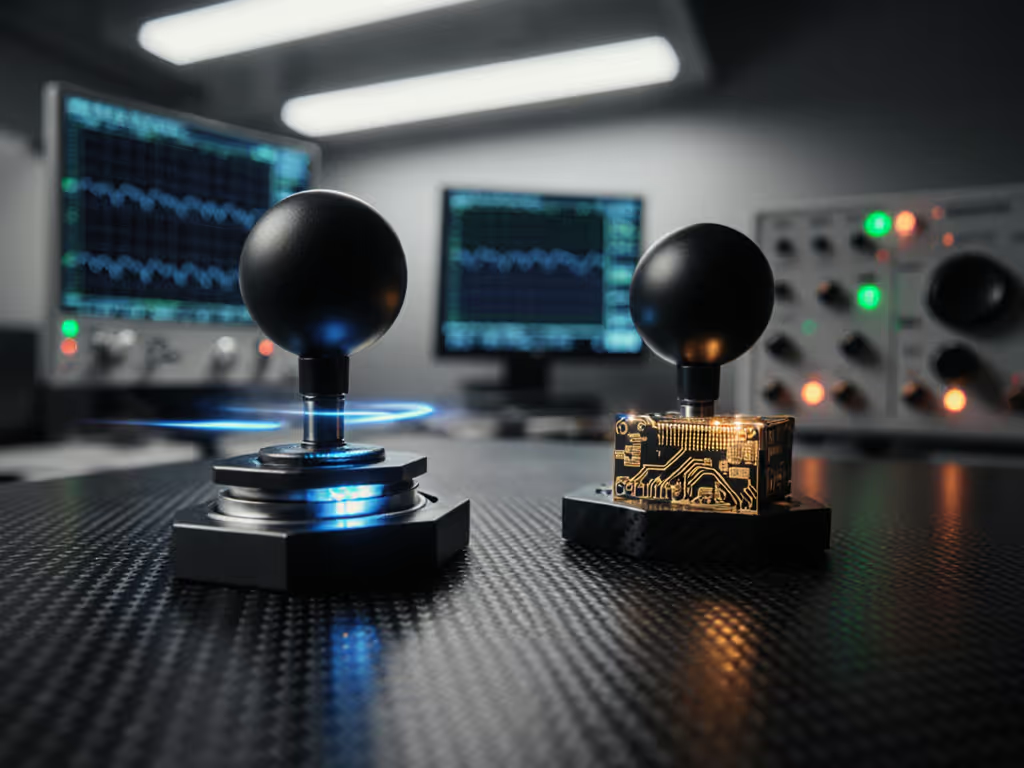
Here's what separates them: Hall Effect sensors detect changes in magnetic field strength, whereas TMR (Tunneling Magnetoresistance) sensors detect resistance changes across a quantum tunnel junction[3]. For a deeper engineering comparison of detection methods and failure modes, read our TMR vs Hall sensor breakdown. The physics matters because the measurement method directly affects how accurately your controller reports stick position under real conditions.
The Physics: Why Sensor Design Changes Everything
Hall Effect technology has served gaming peripherals for years now. It works: no potentiometer friction, no wear, no drift. The core strength is simplicity: a magnet moves, the magnetic field shifts, the sensor registers it[1]. That reliability is why companies like Gulikit and GameSir built thriving product lines around it.
TMR introduces a fundamentally different detection mechanism. Instead of measuring field strength, TMR sensors respond to the quantum tunneling effect across a magnetoresistive barrier[3]. The practical outcome is sensitivity to smaller magnetic field changes, essentially finer granularity in position reporting[2]. In controlled testing, TMR sensors detect magnetic variations that Hall Effect units would treat as noise.
This sounds theoretical. It isn't. When a 0.5-degree stick deflection goes undetected or gets averaged into jitter, competitive players notice.
Latency and Response Accuracy: The Measurable Delta
Latency, meaning true end-to-end latency from stick input to digital signal, depends on multiple factors: sensor read speed, polling rate, and crucially, signal consistency. For protocol-level differences that add or remove delay, see our Bluetooth vs proprietary wireless latency tests. Jitter (small random fluctuations in reported position) creates the functional equivalent of latency because your system must filter or average noisy input, introducing delay.
Here's where the testing gets specific. Hall Effect sensors produce lower jitter than traditional potentiometers[1], but TMR sensors produce very low jitter, measurably lower[1]. One technical consequence: TMR sticks report position more accurately and with less random variation during slow, deliberate movements[1]. This matters most in scenarios that demand micro-adjustments: sniping, careful aim-tracking, or slow-panning navigation.
For sensor longevity testing, both Hall Effect and TMR are contactless, meaning neither experiences mechanical wear[2]. The theoretical lifespan of both is infinite if we're measuring wear alone. The practical difference emerges in environmental resistance: TMR sensors may offer better stability across temperature variations and extreme conditions compared to Hall Effect implementations[2], though real-world controller usage rarely pushes either into those extremes.
The response accuracy gap between Hall Effect and TMR is not massive, but it is real, especially if you're doing slow, precise movements like aiming in an FPS[1]. That's the key qualifier. Casual play? The difference becomes negligible. Precision-demanding scenarios? TMR pulls ahead consistently.
Center Feel and Familiarity: Why Specs Don't Tell the Whole Story
A critical detail often buried in technical specs: how a stick feels in the center dead zone.
Many Hall Effect implementations have a perceptible looseness in the center compared to traditional potentiometer-based sticks (like those in a DualSense or Xbox controller). Players coming from standard controllers often report this as a "floaty" quality, the stick seems less anchored when resting neutral[1]. It's not a failure; it's a characteristic of how Hall Effect sensors handle the magnetic profile around center position.
TMR sticks don't exhibit this to the same degree. The center return feels snappier and more like what players expect from a standard potentiometer stick[1]. For competitive FPS gamers constantly making tiny aiming adjustments, this matters significantly, as a familiar center feel means less adaptation time and fewer missed shots during the transition period.
Power Consumption: The Small Win That Compounds
There's one measurable advantage favoring TMR in battery life: TMR sensors consume slightly less power than Hall Effect sensors[2]. The practical scale: testing found that TMR joysticks deliver approximately 12 extra minutes of playtime over a 12-hour wireless session compared to Hall Effect[1].
That's not a headline-grabbing difference. But for wireless controllers (which Hall Effect adoption struggled with due to power draw[4]), that efficiency gap enabled product categories that didn't previously exist. TMR's lower power footprint removed a significant barrier to wireless gaming peripherals with contactless sensors.
Durability and Longevity: Both Thrive, One Scales Better
Both technologies eliminate the primary failure mode of potentiometer sticks: physical contact wear. Hall Effect sticks are extremely durable because there are no moving electrical contacts[2]. TMR offers similar longevity[2] - another contactless architecture, another effectively wear-resistant design.
The differentiation emerges under stress. TMR's superior resistance to temperature variations and environmental extremes[2] makes it marginally more robust in less-than-ideal conditions. If you're gaming in a truck cab in July or a drafty basement in winter, TMR's thermal stability translates to more consistent stick response year-round.
For typical indoor gaming environments, both technologies deliver reliability well beyond what competitive players typically experience with a controller before upgrading anyway.
The Latency Reality: Context Determines Relevance
Numbers aren't everything, unless they change how the game feels. The question isn't whether TMR is objectively superior; it's whether the superiority manifests in your specific use case.
For competitive FPS players: TMR is measurably better. Lower jitter, higher magnetic sensitivity, and a center feel closer to what competitive players are trained on combine into a genuine performance advantage, particularly for long play sessions where consistency compounds[1].
For casual gamers: Neither will dramatically transform your play. Hall Effect already solved stick drift, the primary pain point. The jitter reduction and accuracy gains from TMR are real but may be subliminal in less demanding genres.
For portable or wireless gaming: TMR's power efficiency becomes relevant. If wireless playtime matters, TMR's efficiency advantage justifies consideration.
For budget-conscious buyers: Hall Effect remains an excellent value. The performance gap doesn't justify double the cost for most players, yet. As TMR manufacturing scales, pricing will compress further[1].
Actionable Next Steps: Choosing Your Sensor
If you're replacing a controller or upgrading from a potentiometer stick:
- Verify the technology: Confirm whether your target controller uses Hall Effect, TMR, or traditional potentiometers. Don't assume based on brand, some manufacturers offer both.
- Match to your primary genre: If you compete in shooters, the precision advantage of TMR justifies the premium. If you rotate between genres, Hall Effect offers a strong middle ground.
- Test the center feel if possible: Borrow a Hall Effect stick and compare it to a TMR implementation. That subjective center response often matters more than latency specifications for day-to-day satisfaction.
- Plan for longevity: Both are contactless and rated for years of use. Durability difference is marginal. Budget accordingly; neither will fail prematurely if you maintain reasonable care.
- Consider your platform: Wireless gaming? TMR's power advantage opens more device options. Wired? The power difference becomes irrelevant.
The measurable gap between Hall Effect and TMR is real but contextual. If you’re deciding whether to pay more now or save upfront, our controller long-term value analysis quantifies durability, repair costs, and feature value over time. Your specific gaming priorities, not the sensor specs alone, determine whether the upgrade makes sense. Test if you can, verify the numbers if you can't, and trust nothing that relies on feel without measurement to back it up.
Related Articles