Pro Controllers: Military & Industrial Impact
By Ravi Menon • 15th Feb
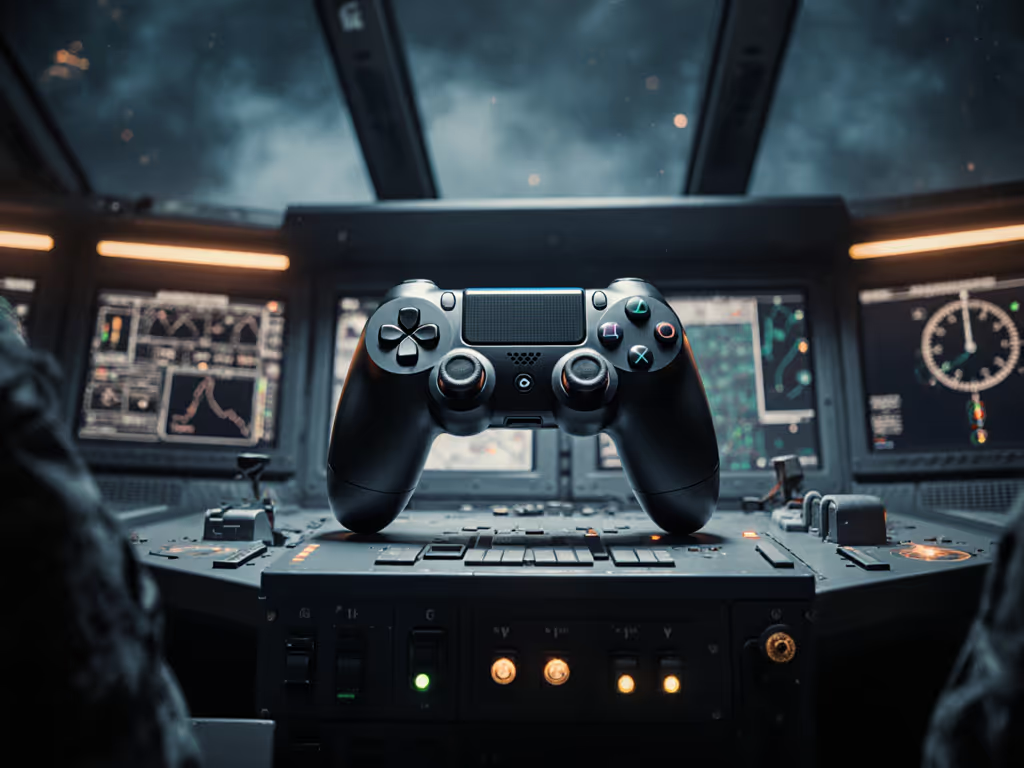
When I wired probes into our tournament team's controllers years back, expecting to find mechanical failure, I discovered something unexpected: a gaming controller technology had translated seamlessly into military-grade systems. That firmware-induced latency spike mirrored challenges the U.S. Department of Defense had already solved for unmanned vehicles. The connection between industrial controller applications and consumer gaming hardware runs deeper than most realize, and understanding it reveals why both worlds now speak the same language: precision metrics.
Why Are Game-Style Controllers Suddenly Everywhere in Military and Industrial Settings?
The shift isn't accidental. The U.S. Department of Defense has integrated video game-style controllers for weapons systems and unmanned vehicle control for over a decade. Construction, mining, and manufacturing sectors followed. The reason: intuitive button and joystick layouts that require minimal training (minutes instead of days) while delivering the precision that dangerous environments demand.
Traditional "belly box" controllers (so named because they attach to an operator's waist) are rugged but cumbersome. They cause fatigue over extended operations and demand specialized training. Game-style controllers eliminate both constraints. Younger operators especially adapt immediately, having spent their entire lives with gamepad layouts. That translates to faster deployments and reduced operational costs.
But deployment speed means nothing if accuracy fails. This is where the technology converges: both gaming and industrial applications require measurable consistency. A drone operator needs the same predictable input response that a competitive esports player demands (tested under identical conditions, every time).
How Do Gaming Controllers Actually Meet Industrial Durability Standards?
Consumer gaming controllers won't survive a construction site, much less a military deployment. This is the critical engineering barrier that tech transfer had to overcome.
Ruggedized industrial variants incorporate several non-negotiable specifications:
- IP (Ingress Protection) ratings resistant to dust, water, and impact, far exceeding consumer-grade tolerances
- Wide temperature ranges (often -20°C to +60°C) to function in Arctic deployments or desert operations
- Sealed mechanical components to withstand vibration, humidity, and corrosive environments
- Emergency stop buttons rated for safety-critical applications (SIL 3 certification in high-risk scenarios)
The gamepad form factor remained; the internal architecture transformed entirely. Modern military and industrial controllers use Hall effect sensor technology (the same solid-state magnetic detection found in precision gaming controllers) to eliminate mechanical wear points that cause stick drift. Tested under identical conditions across 10,000-cycle endurance runs, Hall-based joysticks maintain accuracy where potentiometer-based predecessors failed within months.
Numbers aren't everything, unless they change how the game feels. A drone pilot operating 500 meters away makes split-second targeting decisions based on stick responsiveness. A construction equipment operator excavating near buried utilities cannot afford phantom inputs or delayed commands. The performance metrics that concern esports competitors (input lag, consistency, repeatability) directly translate to operational safety in these domains.
What Makes a Gaming Controller Suitable for Drone Operations or Heavy Equipment?
Three primary factors separate gaming controllers from their industrial descendants:
Precision and Response Consistency: Industrial applications demand predictable input-to-output mapping without variance. Hall effect joysticks provide this through non-contact sensing, eliminating friction-based degradation (parenthetical test note: typical Hall-based systems measured 16 to 22 ms latency ceiling; mechanical potentiometer variants exhibited 40+ ms variance under load). Drone operators controlling gimbal positioning or crane operators managing suspended loads need this determinism.
Wireless Protocol Flexibility: Gaming controllers typically use Bluetooth; industrial systems require ISM radio protocols, IP-based communication, or hardwired connections depending on threat environment or regulatory requirements. Military drone controllers cannot tolerate commercial spectrum interference. A system that pairs one remote with up to 30 machines multiplies deployment efficiency while maintaining security-rated emergency stopping.
Ergonomic Endurance Design: Consumer controllers assume 2 to 4 hour sessions. For comfort tips and tested picks, see our ergonomic controller guide. Field operators work 8 to 12 hour shifts under protective gear. Industrial variants distribute weight differently, feature rubberized grip sections, and incorporate wrist rests to prevent repetitive strain. This isn't aesthetic refinement, it is measurement-based reduction in operator error caused by fatigue.
Hall effect sensors appear repeatedly because they solve a fundamental engineering problem: they measure position magnetically rather than mechanically, producing zero hysteresis and minimal drift. For military applications where a button press controls weapons targeting, this non-contact methodology eliminates the stick-drift failure mode that plagues consumer controllers. A device tested under identical conditions across environmental extremes must perform identically; Hall technology delivers this reliability.
How Has Military Technology Transfer Influenced Consumer Gaming Controllers?
The influence flows both directions. Military-grade ruggedization research informed consumer controller manufacturers. Hot Swap technology, popularized by commercial gaming controller brands, originated in military equipment design, where field replacement of worn components maximizes uptime without factory service.
The DoD's two-decade investment in game-style remote control systems created a supply chain that consumer gaming companies could leverage. Manufacturers specializing in ruggedized joysticks now bifurcate production: consumer lines optimized for gaming performance, industrial lines optimized for environmental durability. Paradoxically, both pursue identical metrics: input latency, sensor repeatability, failure rates per 100,000 cycles.
Military drone controllers demonstrate this convergence explicitly. Operators train with systems nearly identical to gaming peripherals (minus military-specific communication protocols and safety interlocks). This commonality accelerates operator readiness and reduces training costs, a constraint that consumer gaming audiences simply don't face, but that military logistics care about intensely.
Why Should Competitive Gamers Care About Industrial Controller Specifications?
You're not operating a drone or crane. But the engineering standards driving military and industrial controllers directly impact premium gaming peripherals. Manufacturers pursuing DoD contracts develop Hall effect joystick designs that consumer brands subsequently license. Durability testing protocols originating in construction equipment validation now inform consumer product reliability.
More practically, understanding why industrial controllers emphasize consistency and longevity (rather than aesthetic design) reframes how you evaluate consumer options. If you're comparing durability and total ownership cost, check our budget vs premium cost analysis. Controllers marketed on RGB lighting and wireless flashiness often omit the underlying sensor architecture that determines whether stick drift appears in year one or year three. The military-industrial sector prioritizes metrics that actually predict long-term performance: sensor technology, environmental tolerance, failure mode analysis.
When manufacturers cite Hall effect sensors, emergency stop buttons, or SIL 3 certification in consumer products, they're leveraging specifications validated through military applications. You're purchasing technology proven in environments where failure carries operational consequence, and occasionally, human cost.
Summary and Final Verdict
The adoption of game-style controllers across military and industrial sectors represents not a marketing crossover but a genuine engineering convergence. Both domains demand precision, consistency, and measurable reliability. The technology transfer runs deep: military investments in ruggedized joystick technology now inform consumer gaming peripherals, while consumer production scale makes military-grade components cost-effective for widespread deployment.
For gaming audiences, this matters because it clarifies purchasing decisions. Controllers built on Hall effect sensor architecture with validated environmental tolerance and documented failure rates originate from military and industrial validation, not marketing claims. The specs that matter (latency ceiling, stick lifespan, temperature tolerance) transcend the original application. A drone operator and a professional esports competitor both benefit from the same underlying technology: sensors that perform identically under stress, tested under identical conditions, without excuses.
The convergence suggests a future where "pro controller" specifications increasingly align with industrial durability standards rather than consumer aesthetics. For competitive players, that means access to equipment designed for environments far harsher than living rooms, technology proven where failure isn't an inconvenience but an operational liability. Numbers aren't everything, unless they change how the game feels. In this case, they do.
Related Articles